The following Maps are NOT in the same scale.
[ Legend of Maps ] 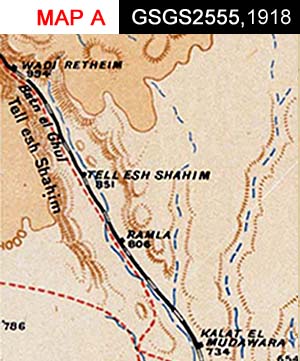
« LEGEND » Place names: In this essay, place names are in standard Arabic spelling, with its variants in square brackets as the case may be on the maps or other sources.
|
It came to my notice that the two stations, Ramlah [Ramleh, Ar/Er Ramla, etc] and Shahm [Tall/Tell/Tulūl esh Shahm, etc] of Hijaz Railway are shown in the opposite way depending on maps. The stations, located to the north of Mudawwara [Mudowwara, Al Mudawarra, etc] in the southernmost part of present-day Jordan, played an important roll as the battleground in SP22 (1922 Oxford Text) Chapters 90 and 105 or Chapters 82 and 94 of the abridged edition.
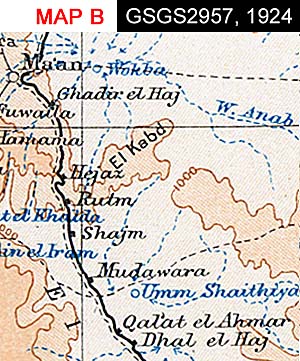
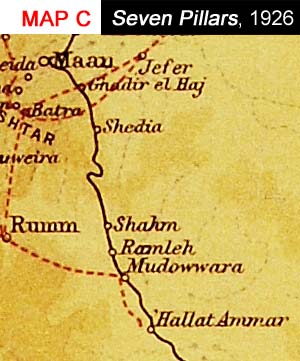
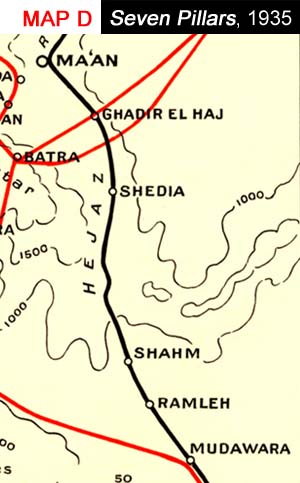
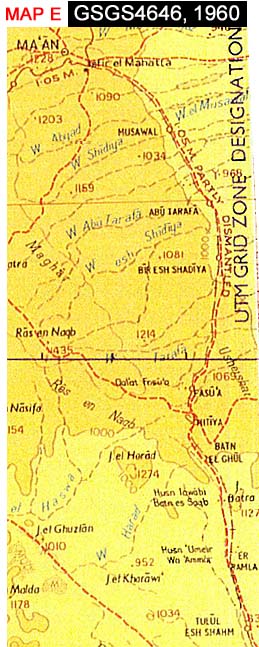
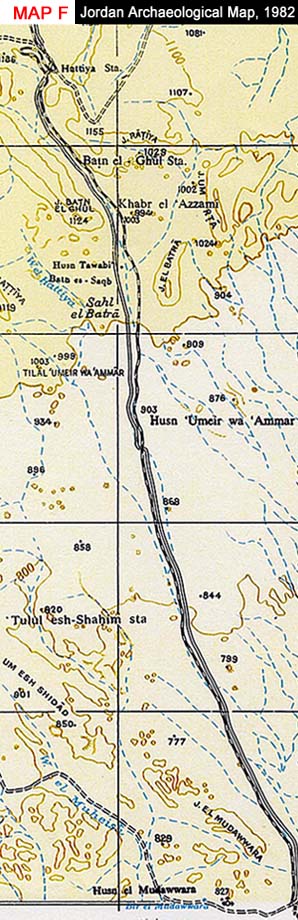
Maps A, B, C and D, referred to in this essay as ‘TEL-Map series,’ show the order of the stations from Mudawwara up northward to be Ramlah and then Shahm, excepting Map B wherein Ramlah is omitted. On the other hand, in Map E, the order is contrariwise, namely Ramlah [Er Ramla] is situated to the north of Shahm [Tulūl esh Shahm]. Map F, though it omits Ramlah, mentions Shahm [Tulul esh-Shahim sta] at the same place as Map E. Probably more important, GeoNames, the GPS-based Geographical Database, endorses the accuracy of Map E and F. Now, the two stations are described in SP22 as under:- ... but it opened straight on Ramleh, the first station north of Mudowwara, and we had to go back and try other ways till evening, when we were at last in place behind the last ridge, a little above Tell Shahm, the second station.With this statement one may well take the order from the south to be Mudawwara, Ramlah and Shahm. But on this first occasion of approaching the railway by a Rolls-Royce tender, Lawrence came down from the northwestern Quweira [Guweira] base. So the readers may think that Lawrence only meant to say that Ramlah was, being closer from Quweira, the first station for him to sight and Shahm the second in the northern area of Mudawwara. In that case, however, readers have to disregard the reverse order of stations in the TEL-Map series. Meanwhile, in the abridged edition (and the later Penguin edition etc), the same part is:- ... and searched through the very nasty low hills till evening, when we were in place behind the last ridge, above Tell Shahm, the second station northward from Mudowwara.Undoubtedly, TEL’s understanding was that the stations were in the order of Mudawwara, Ramlah, and Shahm from the south. The later description of SP22 Ch.105 (Ch.94, Penguin 1962) for April 19, 1918 assault on the “Shahm” station, the first use of armoured cars on the Hijaz Railway, seems to purport the same thing. This is a simple question of which of two stations is nearer to Mudawwara. The truth is that, contrary to Lawrence’s view, Shahm is the first station from Mudawwara. The conclusion seems to be an obvious fact, considering the following three points. 1. The elements of Map E accord with those of GeoNames. Three places of [Tulūl esh Shahm] (station), [Er Ramla] (station), [Husn ‘Umeir wa ‘Ammar] (fort) of Map E are confirmed at the right place by GeoNames. On Map F, [Tulul esh-Shahim sta], [Husn ‘Umeir wa ‘Anmar] and [Tilāl ‘Umeir wa ‘Ammār] (hill) are also confirmed by GeoNames. 2. The geographical location of ‘abandoned railroad station’ of Ramlah, Shahm and Mudawwara in latitudinal/longitudinal coordinates is, according to GeoNames, as follows.
In other words, Shahm station is located at 16.7km latitudinally north of Mudawwara, and Ramla 7.7km north of Shahm. 3. Shahm is certainly one of the stations of which James Nicholson mentioned in his excellent book The Hejaz Railway, Stacey International, London, 2005, that “Stations were built as they were needed, and many of their names represented no more than the actual spot where they were located, with no village or even hamlet having previously existed in the area” (p.25). GeoNames shows Tulūl ash Shahm, a hill of ca. 816m in height and at about 5.6km to the due west of station, hence the station name. Assuming Shahm to be the second station northward from Mudawwara as said in SP, there is no hill around with that name. The counterpart for Ramlah is a hill named [Tilāl ‘Umeir wa ‘Ammār] on Map F, and this is confirmed by GeoNames as [Tilāl ‘Umayr wa ‘Ammār], ca. 878m high, at about 5.7km west of the “abandoned railroad station, Mahattat ar Ramlah.” It is very difficult to know the reason why TEL took Ramlah for Shahm and vice versa. This is just a guess but I suspect that he misunderstood the place because when he came down from Quweira [Guweira] on December 29, 1917 for the first time to test the road for driving the car and to reconnoitre, his party was made up of the British only, with no Arabs who knew the locality. For all that, however, I wonder what Alan Dawnay and other British officers thought of their target when they performed the above-mentioned attack against “Shahm” station on April 19, 1918, in which case, action was taken together with the Arabs. SP describes the minute operation orders planned by Dawnay as: The post would fall and the force would then transport itself to the station of Tell Shahm, which would be shelled by Brodie from the North-West, and bombed by Aeroplanes (at zero 10 hours) and approached by the Armoured Cars from the West.The mention of SP that follows in regard to “Shahm” and “Ramlah” stations would have been different, had “the station of Tell Shahm” in reality been Ramlah. But is it possible that an attack plan was made without maps? Is there no official report of Dawnay or Peake for this particular operation? As far as I know, the Hijaz Railway maps, except Maps E, F and GeoNames, have placed stations in the order of ‘TEL-Map series.’ For instance, according to German Wikipedia, Shahm [Tel el Sham] and Mudawwara [Mudawarra] are shown at kilos.545.0 and 572.0 from Damascus respectively. This seems to presuppose position of Ramlah in between, though omitted in the relative map. The above mentioned Nicholson’s book puts Shahm [Tel Shahm] to the north of Ramlah [Ramleh] (p.36) and shows distance from Damascus to Shahm, to Ramlah and to Mudawwara as 545km, 554km and 572km respectively (Appendix 2, p.184), while Jordan’s Nabataea.net “The Hejaz Railway” places Mudawwara at kilos. 572 but omits Ramlah and Shahm. I wish to know on what grounds these statements could place the location of three stations with the distance from Damascus of that preciseness. I shall be more than pleased if I can straighten this problem, in addition to studying maps, by reading something more concrete, for example original of railway construction plan. It will be necessary to eliminate the confusion, because this is not only an accuracy matter in SP description but can be an actual hazard. Look into the following blog, posted by a member of GARP in November 2007. GARP, the Great Arab Revolt Project is a 10-year archaeological research project being conducted by a team of University of Bristol with support of Jordanian Department of Antiquities and other organizations. JORDAN 2007 GARP DIGThe blog was dated two years ago but it seems that the team carried SP with them as a kind of guidebook. I wonder if it is not needed to replace Shahm of the second paragraph by Ramlah [Ramleh] of the third paragraph. “T. E. Lawrence’s description in his Seven Pillars of Wisdom” in the last sentence denotes SP22 Ch.70, pp. 400-01 or Penguin Ch.64, p.370. 30, September 2009 |
|